The temptation with a new AI assistant is to introduce it to the entire business on day one. Every account, every project, every thing you have been avoiding since Tuesday.
Then it produces a mountain of plausible work, and you acquire a second job checking the mountain.
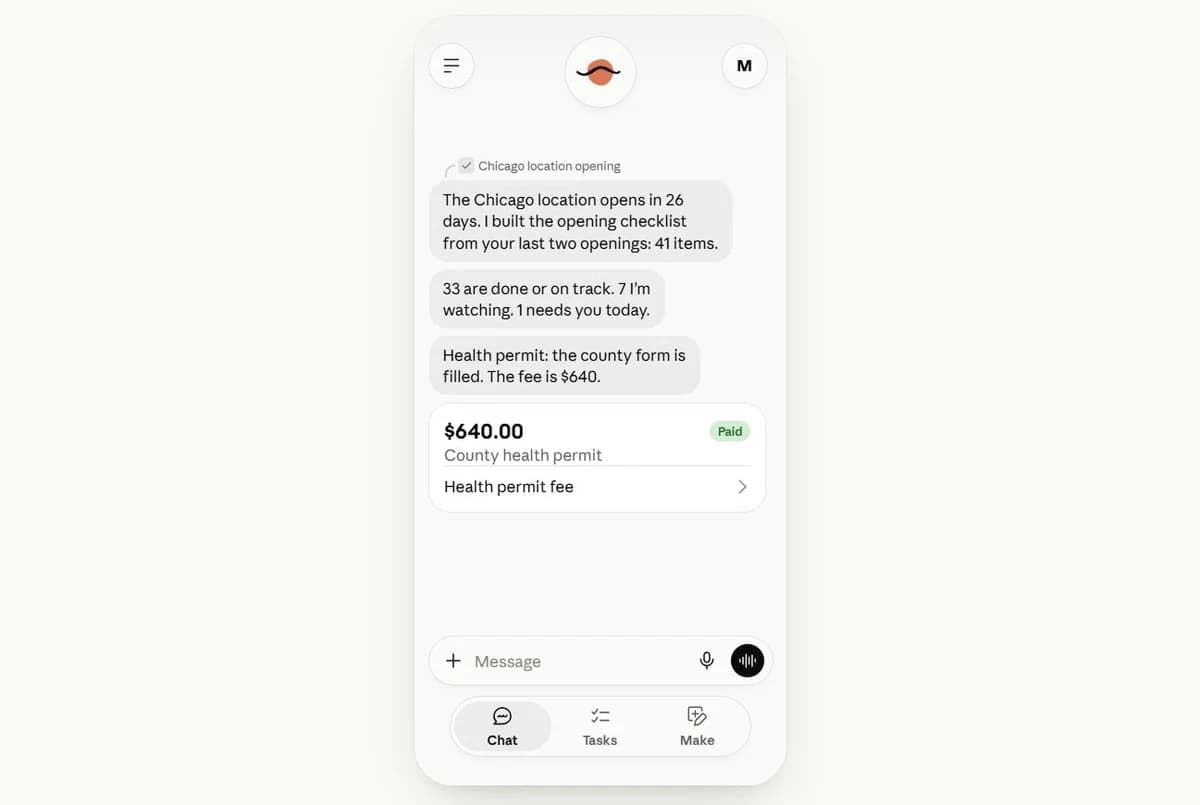
We would start smaller with Claude Duet. Anthropic lists business uses including preparing customer follow-ups and finding unpaid invoices. Announced examples Those are sensible places to look for a bounded task. They are not evidence of how well Duet will handle your records.
This is the evaluation we would run after getting access. It is a proposed plan, not a hands-on review. For rollout details, see our Claude Duet explainer.
Choose the work you already recognise
Pick one recurring job whose quality you can judge without learning a new subject. Customer-call preparation is a good candidate for an owner who already runs those calls. A task involving specialist decisions you cannot independently check is a poor first experiment.
The task should occur often enough to give you several examples. One perfect result can be luck; one disastrous input can be unrepresentative. A week is a useful initial window for daily admin, but a monthly process will need longer.
Before starting, finish one comparable task yourself and note roughly how long it takes. Include the hunting around. Finding the latest email is work, even if no one has invented an impressive job title for it.
- You can tell whether the facts, tone and next step are right.
- A prepared brief or reviewed draft gives you something concrete to assess.
- You can inspect the relevant records without auditing the whole business.
Tap a box as you go. Checks reset when you leave this page.
Define what finished means
Take a customer follow-up. “Write something friendly” leaves the difficult decisions hidden. A useful finished draft should reflect the latest conversation, preserve the actual commitment, make the next step clear and avoid inventing a deadline.
That is a description of the output you need. You do not need an elaborate prompting ritual to know whether an email promises something you never offered.
Agree on a small number of checks before judging the result. Otherwise, it is easy to be impressed by the fluent opening and overlook the incorrect date three paragraphs below it.
For a meeting brief, we would check the customer, the purpose of the call, the latest source, unresolved questions and any proposed decision. We would also look for unsupported certainty. “No answer found” can be much more useful than a confident guess.
Count the work that comes back to you
The generation time is only one part of the job. You still need to read, verify, correct and sometimes restart it.
Here is a deliberately simple example. Suppose you normally spend 25 minutes preparing a brief. Reviewing the assistant's version takes 6 minutes, fixing it takes 4, and recovering from its interruptions costs another 3. You kept 12 minutes: 25 minus 6 minus 4 minus 3.
| Item | Minutes |
|---|---|
| Manual preparation | 25 |
| Review the assisted result | 6 |
| Correct the result | 4 |
| Recover from interruptions | 3 |
| Time kept | 12 |
Worked example only. These are not measured Claude Duet results.
Do not turn that example into a return-on-investment forecast. Your tasks will vary. The calculation is there to stop “it generated something in a minute” becoming the whole evaluation.
Time also misses some value. Catching an overlooked commitment matters even if checking the warning takes five minutes. Record that separately, with enough context to explain why it helped.
Keep a small record of what happened
For each task, note whether you used the output, what needed changing, whether it missed something important and whether its interruptions were worthwhile. Record misses as well as catches; the assistant cannot report everything it failed to notice.
You can download the blank evaluation sheet and open it in a spreadsheet. It contains no client records or prefilled performance claims.
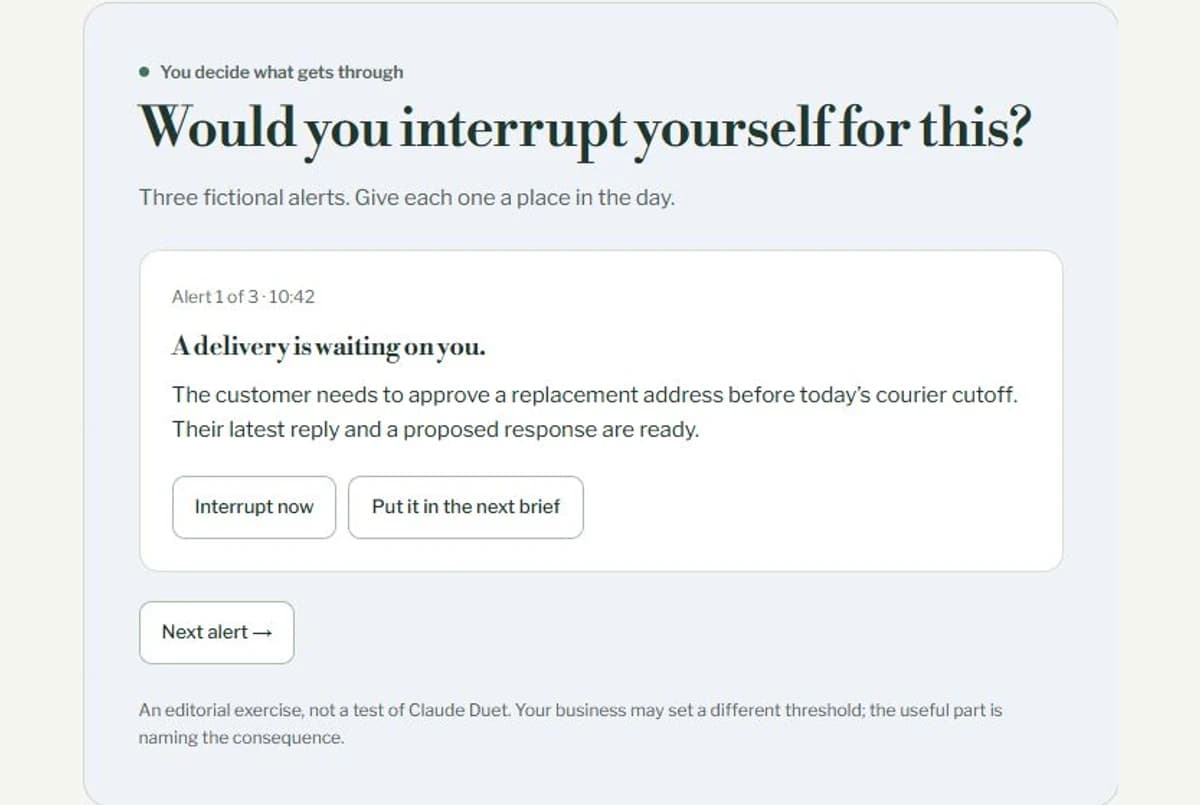
If background activity leaves too little capacity for your other work, record that too. Duet shares your Claude usage limits during the preview. Usage FAQ A task can save attention and still be an awkward fit for your current subscription.
Give it the next job for a reason
At the end of the trial, ask whether the result was useful repeatedly, whether checking it became easier, and whether the mistakes were visible enough to catch before they mattered.
A narrow assignment that works reliably is a good outcome. You do not need to reward the software with access to everything else by Friday.
If it works, add one adjacent task. If it struggles, inspect the cause: incomplete records, an unclear finish, or an output that does not meet the job. Those need different fixes. More enthusiastic instructions will not repair all three.
This is also the kind of judgement that small-business AI training should teach: choosing useful work, recognising a usable result and knowing when to take over. A folder of clever prompts is a weak substitute.