One quote says $2,000. Another says $15,000. Both promise a beautiful website.
Somewhere between those numbers is the part nobody explained.
Website pricing is hard to compare because the noun does so much hiding. A contact page and a store migration can both be called “a website,” in much the same way a bicycle and an ambulance are both transport.
The number starts making sense when you can see who is doing the work, what will be finished and what you will still be paying for two years later.
The cheap quote may have hired you
Look for three small words: “content supplied by client.”
That might be exactly what you want. You have the copy, photographs and product information ready to go. Fine.
If you don’t, the lower quote has quietly made you the writer, picture editor and catalogue manager. Those jobs still exist. They are now waiting for you after dinner.
Check the same thing for old URLs, product entry, booking tools and forms. Is the supplier handling them? Are you? Has anyone mentioned them?
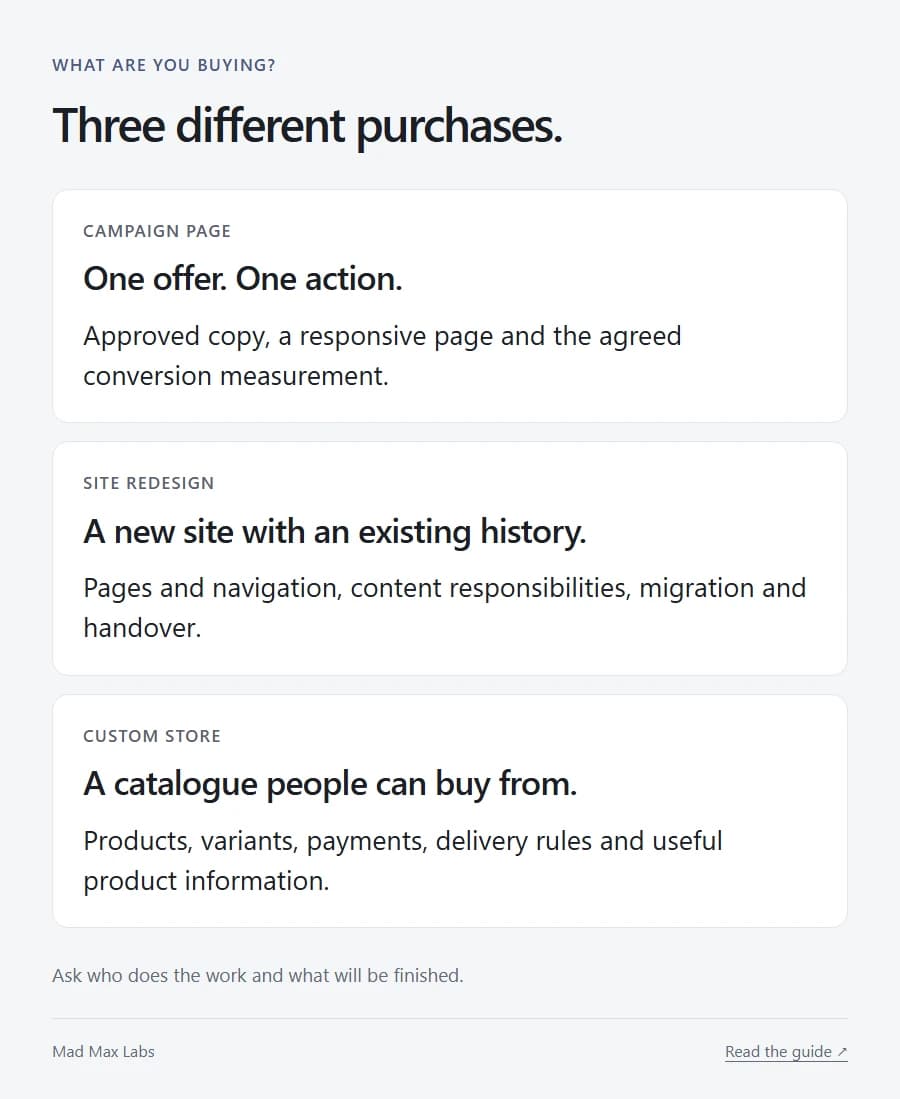
A five-page site can involve five ready-to-publish pages or five weeks of deciding what the business is trying to say. Page count is a poor substitute for scope.
Some actual numbers from our shop
Here are Mad Max Labs’ published ranges in USD:
- A landing page with copy and tracking: $3,000–$6,000.
- A site redesign with SEO migration: $8,000–$18,000.
- A custom Shopify or WooCommerce store: $12,000–$35,000.
These are our offers, checked on 21 October 2026. The scope determines your quote.
Would I tell every small business to spend that? No. If you need a simple presence, have decent content and are happy to manage it, a good template can be a sensible purchase. Five straightforward pages do not require a software epic.
The case for a larger budget gets stronger when the work involves writing, a complicated catalogue, an existing site that must survive the move or a buying journey that needs careful attention.
Ask the supplier to connect the money to things you can recognise. Finished pages. Migrated products. Working forms. Accounts you can access. You should be able to understand the purchase without attending a lecture on their production method.
The invoice is only the beginning
The build fee gets your attention. The renewals arrive quietly.
For an example two-year budget, take a $6,000 build, a $50 monthly platform bill, $100 a month for maintenance, a $25 annual domain renewal and $800 of content work.
That totals $10,450 before tax, payment fees, usage charges or later additions.
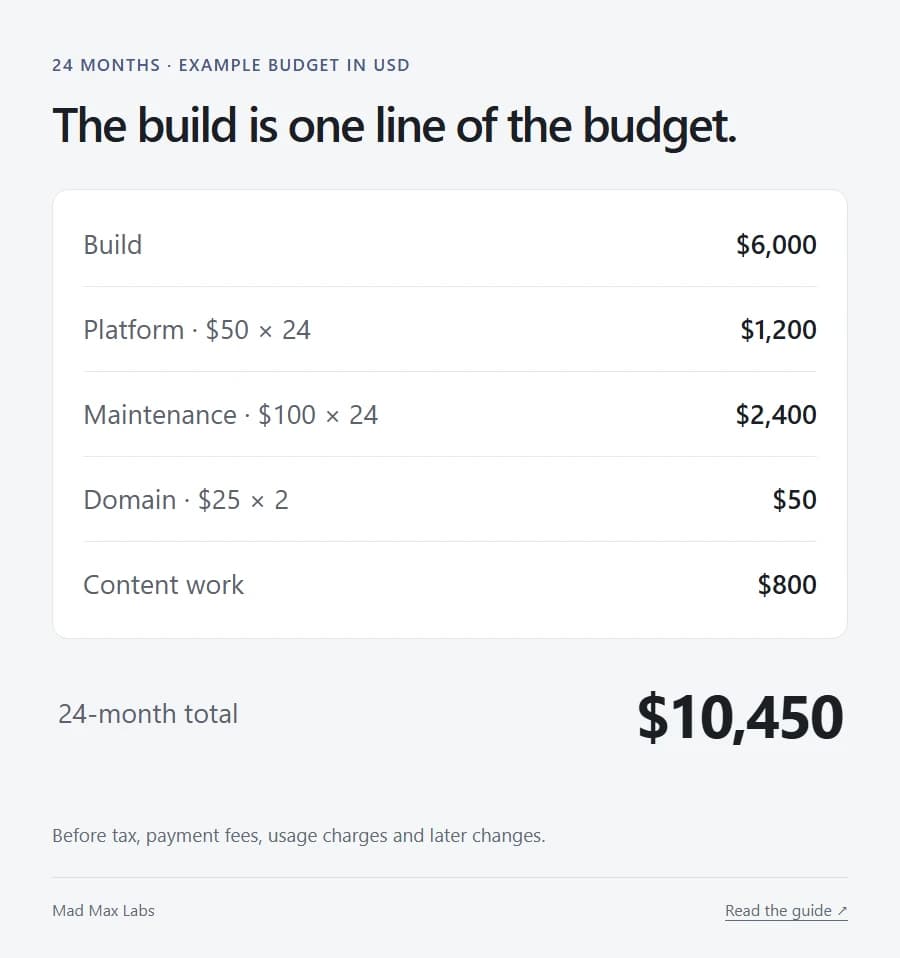
Now ask what “maintenance” buys. Fixing a broken form, applying updates and designing a new page are three different jobs. A monthly fee with no defined coverage is a number waiting to become an argument.
The same scrutiny belongs on every optional subscription. A small service site may have no use for an elaborate CRM or a paid review widget. Ask what earns its place.
Take the keys before you admire the paint
Can you sign into the domain account? Who controls the hosting, content system and analytics? What happens if you decide to work with someone else?
These questions feel dull right up until the day they become urgent.
Ask which licences transfer with the site and which belong to the supplier. A font, theme or extension may have its own terms. Source-code ownership does not cancel a third-party subscription.
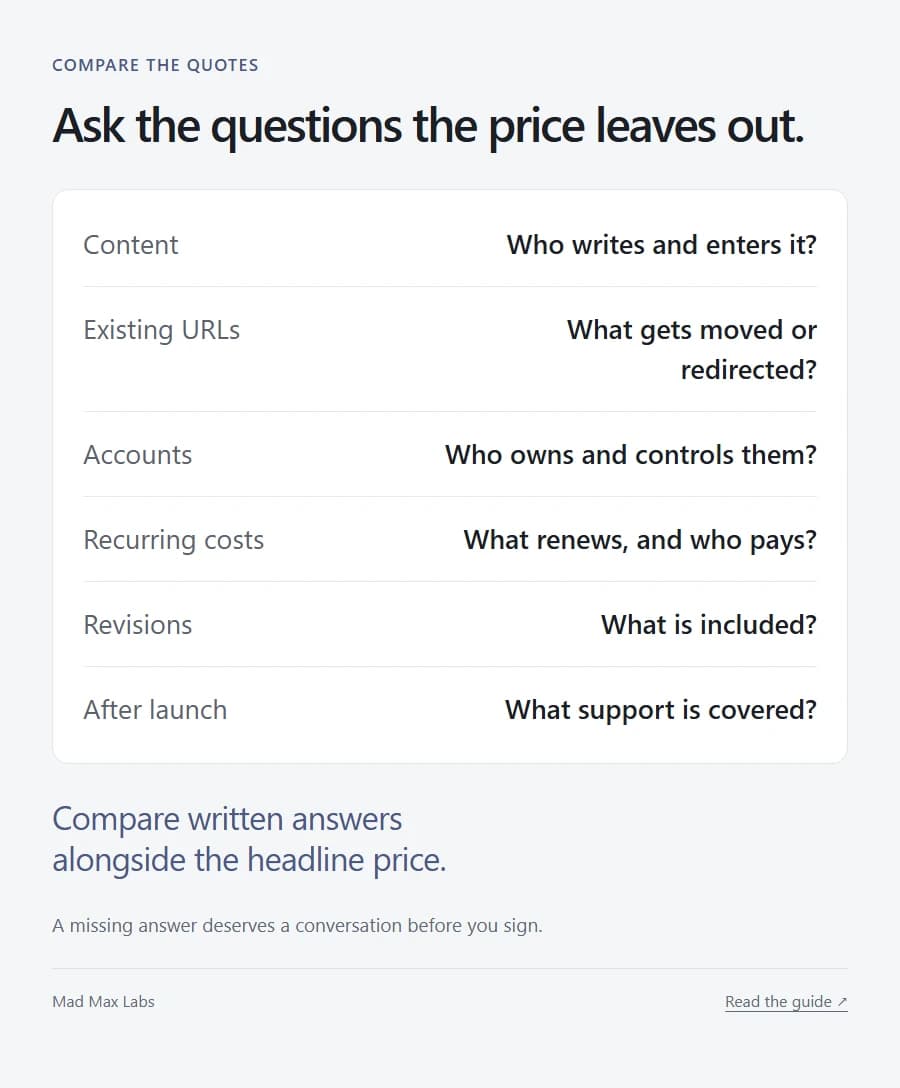
Have the supplier explain the exit in ordinary language. You should know what you can take, what will keep running and what another person would need to maintain it.
Name the expensive bits early
A second language, an untidy product catalogue, customer records to migrate or an unusual booking arrangement can change the work considerably. Mention them before the proposal becomes a signed agreement.
You don’t need to have solved every detail. You do need to stop treating the difficult parts as surprises for later.
Get the revision allowance, milestones and completion criteria into the scope. Use the website launch and handover checklist when the finished site arrives.
A clear $10,000 proposal can be easier to trust than a mysterious $3,000 one. The useful price is the one you understand before you pay it.